
For cleanroom contractors, facility engineers, and procurement teams, panel core selection affects more than wall build-up. It drives structural performance, particulate control, installation speed, ceiling loading, fire strategy, lifecycle cost, and long-term compliance. In regulated environments, the wrong core choice can create avoidable issues in span stability, thermal control, overhead load planning, and code review.
That is why cleanroom panel procurement should start with technical fit, not just price per square foot. Core composition changes how a panel behaves under load, how it performs in fire-critical zones, where it can be used overhead, and how well it supports strict cleanliness targets aligned with ISO 14644-1 cleanroom classification requirements. For buyers comparing modular wall panels specifications, cleanroom panel dimensions, and sandwich panel details, the right answer depends on the facility use case.
Moddulx manufactures factory-direct modular walls in-house from Windsor, Ontario, supplying aluminum honeycomb, EPS, and rockwool panel systems for controlled environments across North America. With ±0.5 mm manufacturing tolerance, ISO 14644-1 compliance across panel systems, GMP documentation, and more than 200 delivered projects, Moddulx supports buyers who need custom fabrication scale, direct accountability, and installation timelines that run up to 2x faster than site-built construction.
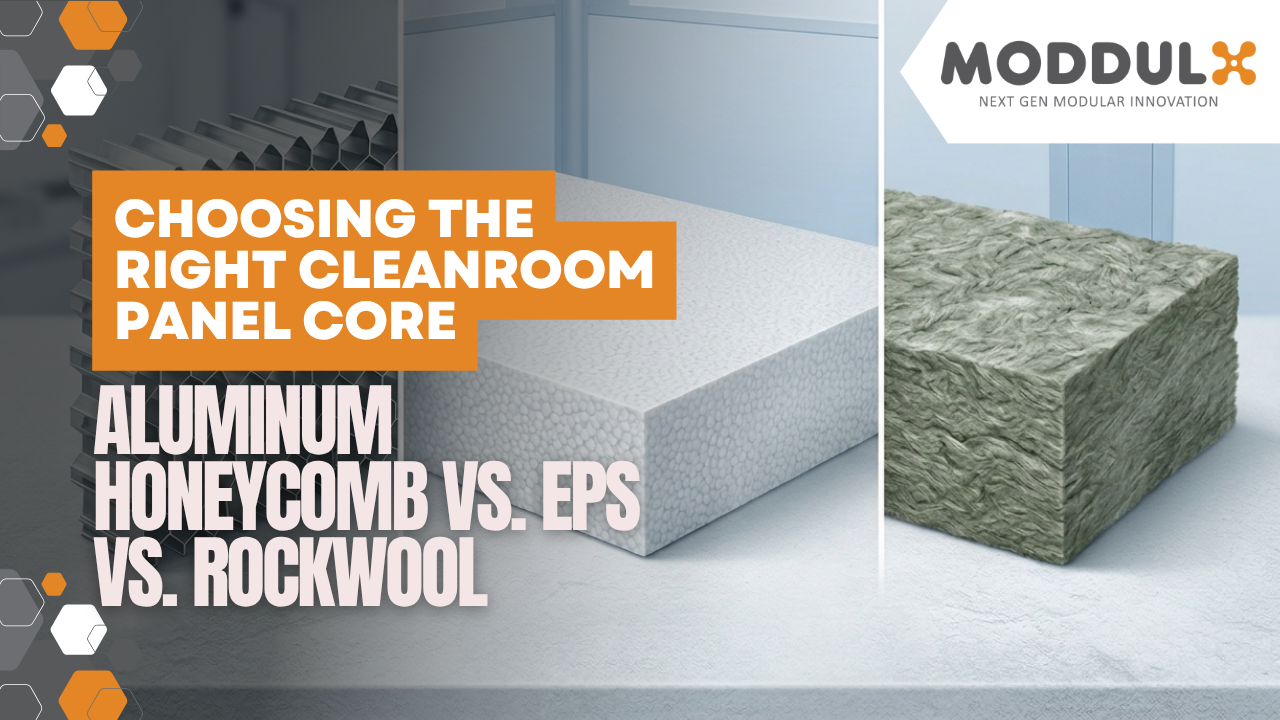
This guide compares the three primary core options used in cleanroom partition systems: aluminum honeycomb panel core, EPS modular partitions, and fire-rated rockwool panels. The goal is simple: help you match core type to performance priority, regulatory demand, and project economics.
Why Core Material Matters in Modular Wall Panels Specifications
When teams review modular wall panels specifications, they often focus first on finish type, panel thickness, or cleanability. Those factors matter, but the internal core is what largely determines structural behavior. It influences whether a panel is self-supported, whether it is suitable for walkable ceiling applications, how much dead load the structure must carry, and how the assembly responds in fire-rated or temperature-controlled conditions.
In practical terms, panel core selection affects:
- Wall rigidity and resistance to deflection
- Weight-to-strength ratio for transport and installation
- Suitability for walkable versus non-walkable ceiling layouts
- Fire performance and non-combustibility requirements
- Thermal behavior in temperature-sensitive zones
- Acoustic value in process or utility-adjacent spaces
- Best-fit industry use by contamination sensitivity and code profile
At Moddulx, verified product offerings include 50mm and 25mmsandwich panels plus 10mm liner panels across available core options. The 50mmformat is the primary structural cleanroom panel build for self-supported wall sand, depending on core type, walkable ceiling use. The 25mm format serves non-walkable ceiling applications where lower overhead weight is required. The10mm liner format is used as an overlay on existing walls where minimal disruption is a priority.
For buyers reviewing manufacturing specifications for cleanroom wall configurations, the key is to align panel thickness and core material with the facility’s performance priorities rather than forcing one core across every room type.
Cleanroom Panel Dimensions and Sandwich Panel Details at a Glance
Before comparing each material, it helps to frame the available cleanroom panel dimensions and sandwich panel details in a practical procurement context:
- 50mm sandwich panels: Primary structural format used for self-supported walls and selected walkable ceiling applications
- 25mm sandwich panels: Reduced-profile format used for non-walkable ceilings where lower weight is important
- 10mm liner panels: Overlay format for existing wall upgrades without major structural changes
Some project teams may benchmark against 100mm panels because that thickness appears in broader industry comparisons for high-insulation or specialty wall assemblies. However, Moddulx-specific product data in the verified catalog is grounded in 50mm, 25mm, and 10mmconfigurations. Where 100mm appears in this article, it is discussed only as general market context, not as a validated Moddulx stock offering.
.jpg)
Aluminum Honeycomb Panel Core
Structural Rigidity
The aluminum honeycomb panel core is the highest-rigidity option in the Moddulx product range for cleanroom use. The cellular core structure provides excellent flatness and dimensional stability, which is critical in environments where panel alignment, airtight joints, and flush surfaces support contamination control. In practice, this makes honeycomb a strong fit for facilities that cannot tolerate panel flex, waviness, or long-term drift at joints.
Moddulx lists its 50mm aluminum honeycomb sandwich panel asself-supported and suitable for walls and walkable ceilings, while the 25mmversion is positioned for non-walkable ceilings. That distinction is important for design teams reviewing structural layouts. Where ceiling traffic, maintenance access, or span stability matter, honeycomb offers a strong performance case.
Weight-to-Strength Ratio
Among the three core types, aluminum honeycomb typically offers the best weight-to-strength ratio. That means a panel can remain relatively light while still delivering high rigidity. For contractors, this can support easier handling and tighter installation accuracy. For engineers, it can reduce unnecessary structural burden compared with heavier fire-focused assemblies in areas where fire rating is not the main driver.
This combination of low mass and high stiffness is one reason aluminum honeycomb is often specified in high-precision cleanrooms. When project teams assess ceiling loads, panel spans, and walkable overhead requirements, reviewing cleanroom ceiling panel weights, spans, and walkable sandwich panel details becomes essential during design coordination.
Fire Compliance
Honeycomb is a strong contamination-control and structural option, but it should not automatically be treated as the fire-first choice in every project. If the project scope includes strict non-combustibility requirements, rated barriers, or code-driven fire compartment strategies, rockwool may be the more suitable specification. Honeycomb performs best when rigidity, flatness, and cleanroom precision are the leading priorities.
Best-Fit Industries
The aluminum honeycomb panel core is especially well suited to:
- Semiconductor facilities: where surface flatness, particulate control, and stable panel alignment matter
- Pharmaceutical cleanrooms: where smooth surfaces, sealed joints, and consistent wall geometry support sanitation protocols
- Biotech laboratories: where dimensional stability helps maintain reliable cleanable interfaces
- Medical manufacturing environments: where controlled surfaces and long-term panel consistency are required
For buyers prioritizing precision over lowest upfront cost, honeycomb is typically the premium structural choice in factory-direct modular walls.
EPS Modular Partitions
Structural Rigidity
EPS modular partitions provide reliable structural performance in a cost-efficient format, especially at the 50mm sandwich panel level. Moddulx identifies the 50mm EPS panel as self-supported for walls and walkable ceilings, which makes it viable for many cleanroom and controlled environment builds where thermal performance and budget matter more than maximum flatness.
Compared with aluminum honeycomb, EPS is generally less rigid under equivalent conditions. That does not make it unsuitable. It means EPS should be specified where its advantages match the project brief: stable insulation, lighter cost profile, and broad usability across industrial and temperature-controlled spaces.
Weight-to-Strength Ratio
EPS performs well as a lightweight insulated core with practical structural utility. It does not usually match the stiffness profile of an aluminum honeycomb panel core, but it provides a balanced combination of usable strength, manageable weight, and cost control. In large square-footage builds, that balance can materially improve budget efficiency.
The 25mm EPS ceiling panel is also the most cost-effective overhead option in the verified Moddulx catalog, making it a practical solution for non-walkable ceilings in temperature-controlled applications where reducing overhead load and controlling material cost are both priorities.
Fire Compliance
EPS should not be treated as the default choice where fire performance is the leading design criterion. It is better positioned for thermal efficiency and cost-effective partitioning than for non-combustible barrier strategies. If the project is subject to heightened fire code scrutiny, utility separation requirements, or battery-production risk mitigation, fire-rated rockwool panels are typically the stronger fit.
Best-Fit Industries
EPS modular partitions are commonly suited to:
- Pharmaceutical support spaces: where thermal control and clean finishes matter
- Food processing areas: where washdown-compatible surfaces and insulation value are important
- Temperature-controlled manufacturing: where stable thermal performance supports process consistency
- Large industrial builds: where budget efficiency at scale is a major procurement factor
For procurement teams balancing function and cost, EPS often represents the most economical path to compliant, factory-direct modular walls without stepping outside core cleanroom performance requirements.
Fire-Rated Rockwool Panels
Structural Rigidity
Fire-rated rockwool panels provide solid structural performance, particularly in 50mm sandwich panel form, where Moddulx identifies them as self-supported for walls and walkable ceilings. While rockwool is not typically chosen for the same weight-efficient rigidity profile as honeycomb, it delivers dependable panel integrity in applications where fire safety is part of the primary specification.
Rockwool also brings a secondary benefit that matters in many facilities: acoustic dampening. In manufacturing zones adjacent to process equipment, mechanical spaces, or high-activity corridors, this can add practical value beyond basic code compliance.
Weight-to-Strength Ratio
Rockwool usually carries more weight than aluminum honeycomb or EPS for a comparable assembly. That means its weight-to-strength ratio is less favorable when the sole objective is minimizing dead load. However, that tradeoff often makes sense where the design must deliver non-combustible core performance and better acoustic control.
For design teams, this is where specification discipline matters. If the project calls for overhead walkability and fire performance, a50mm rockwool panel may be the correct answer despite added mass. If the zone is non-walkable and overhead loading is tightly constrained, a 25mm panel maybe more appropriate, provided the application and support structure are aligned with the design intent.
Fire Compliance
This is the defining strength of fire-rated rockwool panels. The mineral wool core is non-combustible, making it the strongest option among the three when fire resistance is a code requirement or facility risk factor. In pharmaceutical manufacturing, EV battery production, utility-adjacent partitions, and regulated industrial spaces, this can be the deciding variable.
Where buyers need to document cleanroom performance alongside life-safety requirements, rockwool often provides the clearest route to a compliant specification set. It supports projects that cannot compromise on fire behavior while still requiring cleanable modular panel construction.
How to Choose the Right Core for Your Facility
In most cleanroom projects, the right panel core comes down to the primary design constraint. A useful way to approach the decision is to rank your project needs in order:
- Choose aluminum honeycomb when flatness, rigidity, clean geometry, and premium structural performance are the top priorities.
- Choose EPS when thermal behavior, budget efficiency, and broad functional performance are the main drivers.
- Choose rockwool when fire safety, non-combustibility, and acoustic control must lead the specification.
It is also common for larger facilities to combine core types by room function. A semiconductor process zone may justify an aluminum honeycomb panel core, while adjacent utility or fire-separated areas may be better served by fire-rated rockwool panels. Likewise, a food or temperature-controlled production area may use EPS modular partitions for efficient thermal control while maintaining cleanable surfaces and compliant installation details.
For procurement teams, this is where manufacturer capability matters as much as product type. Moddulx supports factory-direct modular walls with in-house production in Windsor, Ontario, custom fabrication scale, and single-source accountability from panel fabrication through project delivery. That reduces the risks that come with distributor layers, split sourcing, and field improvisation.
.jpg)
Why Moddulx Matters in High-Compliance Panel Procurement
Panel core selection is only as good as the manufacturer’s consistency. In controlled environments, tolerance control, repeatability, and documented compliance are not optional. Moddulx brings several procurement advantages that directly affect project execution:
- Direct manufacturer model: factory-direct pricing without distributor markup layers
- In-house production: panel fabrication completed in Windsor, Ontario
- ±0.5 mm manufacturing tolerance: tighter fit and more predictable installation outcomes
- ISO 14644-1 compliance across panel systems: aligned with cleanroom performance expectations
- GMP documentation included: supports regulated project requirements
- 2x faster install versus site-built construction helps compress shutdown and build schedules
- 200+ delivered projects across North America: proven capacity for commercial-scale execution
Whether you are finalizing cleanroom panel dimensions for anew pharmaceutical suite, comparing sandwich panel details for a semiconductor ceiling layout, or reviewing modular wall panels specifications for an industrial retrofit, the value is in getting the core selection right before procurement locks.
Request Direct-Factory Pricing from Moddulx
If you are specifying a cleanroom build, expansion, or retrofit, now is the right time to align panel core, thickness, finish, and compliance requirements with a direct manufacturer. Moddulx supplies factory-direct modular walls with custom fabrication support, verified panel system options, and production capacity built for commercial-scale controlled environments.
Request direct-factory pricing for your cleanroom panel specification to review core options, application fit, and project-specific manufacturing requirements with the Moddulx team.