

Environmental Testing Cleanroom Design: Airflow, Humidity & Particulates
TL;DR: Environmental testing cleanrooms require wall and ceiling panel systems that maintain differential pressure, block moisture transmission, and shed zero particles. Panel core selection-aluminum honeycomb, EPS, or Rockwool-directly determines whether an enclosure meets ISO 14644 classification, passes environmental monitoring audits, and holds stable across thermal and humidity cycling.
Environmental monitoring fails before sampling begins. The particle counter doesn't lie - but when counts spike, the cause is rarely the process. It's the enclosure. A joint that admits 0.3% air leakage is enough to collapse a differential pressure cascade. A wall panel core that off-gasses under thermal load introduces background contamination that invalidates test data. A ceiling surface with microscopic pitting accumulates particulate between cleaning cycles and releases it during air changes.
Pharmaceutical validation engineers, quality control managers, and facility architects designing environmental testing cleanrooms share the same problem: the structural shell must perform as a precision instrument. This post addresses how panel selection and enclosure design directly govern the environmental variables that ISO 14644-2 environmental monitoring programs measure.
What Are the Critical Environmental Factors in Testing Enclosure Design?
An environmental testing cleanroom serves one function-producing controlled, repeatable environmental conditions that accurately reflect the process under test. Three variables determine whether that function is met.
How Does Temperature and Humidity Stability Affect Testing Accuracy?
Temperature drift and moisture ingress are the primary sources of measurement error in climate-controlled test chambers. EV battery dry rooms require dew points as low as -40°C.
Standard panel constructions are not designed for these conditions. Moisture transmission occurs at two points: through the core material and through the panel joint. An EPS Insulated Panel core provides stable thermal resistance, R-values remain consistent across decades of temperature cycling. Tight panel-to-panel joint profiles limit vapor diffusion at the seam. Together, these two design elements prevent the condensation and humidity variation that compromise test validity.
The consequence of using an undersized or inappropriate panel core is not gradual degradation. It is a failed validation study and a protocol repeat.
Why Does Differential Pressure Retention Depend on Joint Profile?
Positive pressure cascades in pharmaceutical testing suites and negative pressure containment rooms both depend on the same variable: the airtightness of the panel joint. A tongue-and-groove joint profile, cold-welded and silicone-sealed at installation, eliminates the air bypass paths that degrade pressure differentials over time.
According to ISO 14644-2 environmental monitoring protocols, pressure differential between adjacent classified zones is a primary classification parameter. A room specified at 12.5 Pa positive pressure relative to its anteroom does not hold that differential if panel joints allow bypass airflow. Remediation after commissioning is expensive. Enclosure design that builds airtightness into the joint profile prevents that outcome.
Moddulx modular cleanrooms are manufactured to ±0.5mm panel tolerances, with joint profiles detailed and approved before production begins. That dimensional precision is what makes a pressure differential hold.
How Do Panel Surface Properties Affect Particulate Control and Monitoring Audits?
An environmental monitoring audit measures what is in the air. Any surface that generates particles - through abrasion, thermal expansion, corrosion, or chemical reaction adds to that count. The result is a false positive that cannot be distinguished from process contamination.
Aluminum Honeycomb Panels facings address this directly. The sealed aluminum surface does not shed particles under normal operational conditions. The non-porous finish does not accumulate contamination between cleaning cycles. Anti-static surface properties prevent particle attraction and re-entrainment during air changes.
For facilities that follow IEST contamination control guidance or operate under FDA environmental monitoring guidance, zero outgassing and zero particle shedding from wall and ceiling surfaces are baseline requirements, not performance goals. The panel surface must not be a contamination source.
How Should Panel Core Selection Match Testing Enclosure Requirements?
Core selection is not a cost decision. It is a technical specification that determines which ISO classifications an enclosure can achieve and maintain.
When Should Aluminum Honeycomb Panels Be Specified?
Aluminum Honeycomb Panels are the correct specification for ISO Class 1–5 sterile testing chambers and any application where surface integrity governs monitoring outcomes.
The honeycomb core delivers exceptional flatness - panel faces hold dimensional stability across temperature cycles that cause other cores to bow or delaminate. That flatness matters at ceiling level: a walkable ceiling panel that deflects under load creates joint gaps that break airtightness and introduce contamination pathways. Aluminum honeycomb panels are rated for 40 lb/ft² walkable ceiling load, making them suitable for self-supporting ceiling spans without secondary steel.
Specify aluminum honeycomb when:
- The enclosure targets ISO Class 1–5 classification
- Zero particle shedding from wall and ceiling surfaces is a monitoring requirement
- Walkable ceiling construction is required for HVAC or filter access
- Surface flatness is a dimensional tolerance in the enclosure specification
When Should Rockwool Fire-Rated Panels Be Specified?
Rockwool Fire-Rated Panels are specified for thermal testing, battery stress testing, and fire-barrier wall assemblies where non-combustible construction is a code or safety requirement.
EV battery stress testing enclosures require fire-compartmentalization by design. A thermal runaway event during testing must be contained within the test cell. The Rockwool mineral wool core is non-combustible - it does not contribute to flame spread. Rockwool panels carry UL listing and pass ASTM E84 Class A fire testing. For pharmaceutical facilities running flammability or thermal cycling studies, the same fire resistance properties apply.
Specify Rockwool when:
- Battery stress testing or thermal runaway containment is required
- Fire-barrier walls between test cells are mandated by code
- Acoustic insulation between adjacent test chambers is a facility requirement
- Non-combustible construction is a life-safety or insurance requirement
When Should EPS Insulated Panels Be Specified?
EPS Insulated Panels are the primary specification for climate-controlled test chambers, cold storage validation suites, and any enclosure where thermal resistance is the governing performance criterion.
The expanded polystyrene core provides the highest R-value per panel thickness of the three core constructions. Stable R-values across decades of temperature cycling without the thermal drift that degrades less stable insulation cores make EPS the right choice for long-duration validation studies. Airtight joint profiles on EPS panels limit vapor transmission at the seam, addressing the condensation risk that undermines ultra-low humidity dry-room performance.
Specify EPS when:
- The enclosure is a climate chamber with defined temperature and humidity set points
- Cold storage validation requires precise thermal boundary performance
- EV battery dry-room construction requires moisture exclusion at the panel joint level
- Thermal resistance is specified in the enclosure's performance criteria
Panel Core Comparison for Environmental Testing Cleanrooms
How Should Environmental Monitoring Hardware Be Integrated Into the Enclosure?
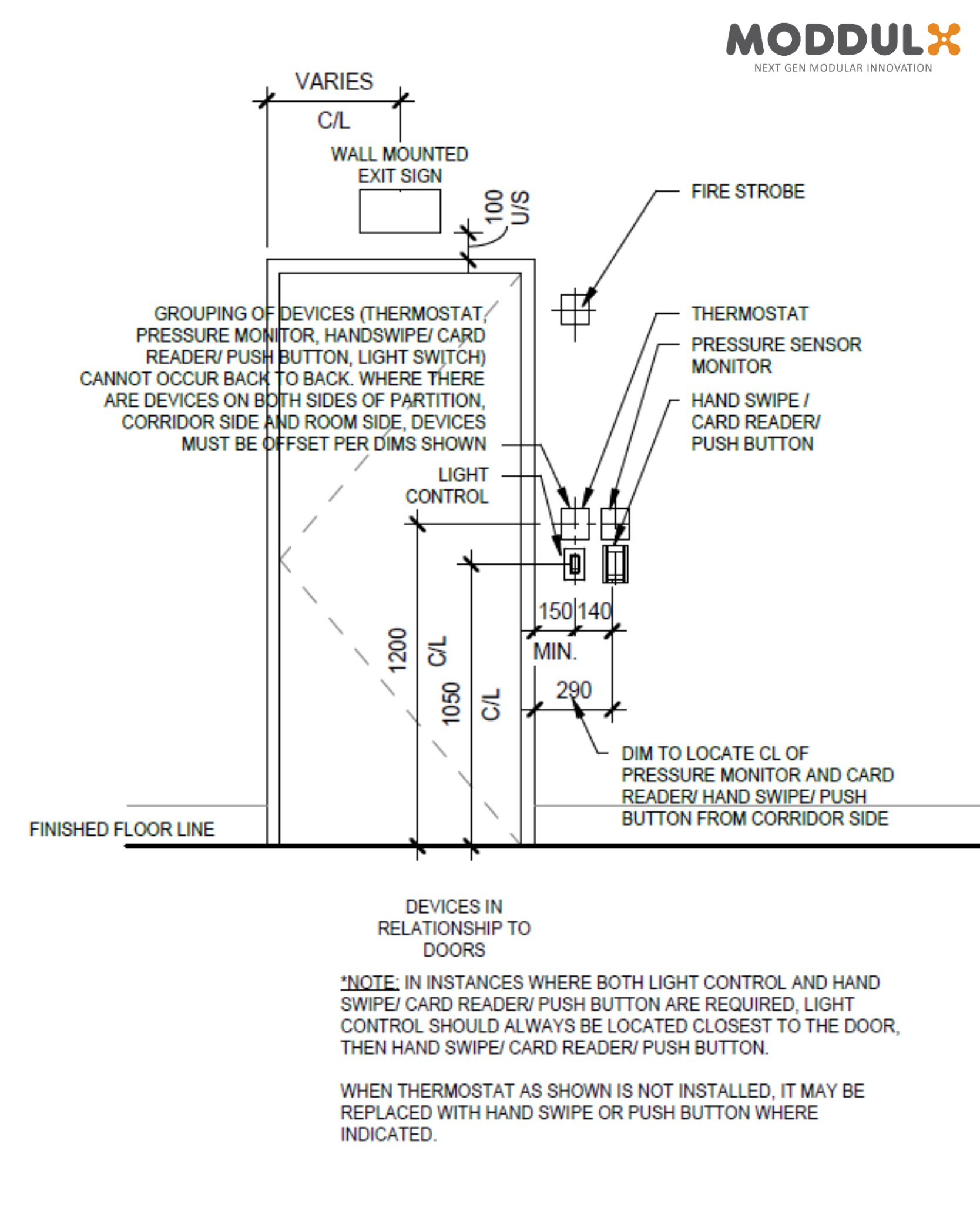
Monitoring hardware that penetrates a classified wall or ceiling creates a contamination pathway if the penetration is not engineered before panel production. Field-cut penetrations - drilled or routed after installation - are the most common source of airtightness failures in environmental testing cleanrooms.
Pre-engineered solutions eliminate that risk. Utility chases built into the panel system route sensor cabling and sample lines without surface penetrations. Flush-mounted sampling ports, sized and positioned on the fabrication drawings, maintain the panel surface plane at the monitoring point. Pass-through boxes integrated into the wall system allow sample transfer without pressure-zone compromise. HVAC HEPA ceiling cutouts prevent the gap-and-turbulence conditions that generate false particle counts at the filter face.

Each of these details must be resolved before panels go into production - not after the enclosure is commissioned. Every field modification after installation is a validation risk.
For pharmaceutical facilities, this approach aligns directly with the guidance in Moddulx's pharmaceutical hygiene blog, which outlines how pre-engineered panel penetrations support GMP compliance and reduce remediation events during qualification.
Structural Design Determines Validation Outcomes
Particle counts, pressure differentials, humidity set points, and temperature stability are the metrics that environmental testing cleanrooms exist to control. Each one is governed, in part, by the panel system that forms the enclosure boundary.
The wrong panel core creates thermal drift that invalidates climate chamber test data. Incorrect joint profiles allow pressure cascade failures that require post-commissioning remediation. Non-engineered monitoring hardware penetrations introduce contamination pathways that generate false positives during environmental audits. These are not theoretical failure modes—they are the documented causes of qualification failures in testing enclosures across pharmaceutical, semiconductor, and EV battery applications.
Specifying the correct panel system from the outset - matched to the enclosure's ISO classification, thermal requirements, and monitoring hardware layout - is the most direct path to a cleanroom that passes qualification on the first attempt.
Moddulx manufactures engineered cleanroom panel enclosures to tolerances, with airtight joint profiles, pre-engineered monitoring hardware cutouts, and direct-manufacturer lead times of 2–4 weeks from spec approval. Every panel run is cut to your drawings, certified to ISO 14644 and GMP standards, and shipped site-ready across the US and Canada.
Submit your testing chamber drawings to contact our engineering team for factory-direct engineering support and rapid turnaround pricing.
Frequently Asked Questions
What is an environmental testing cleanroom?
An environmental testing cleanroom is a controlled enclosure designed to maintain precise, stable conditions - including particulate concentration, temperature, humidity, and differential pressure - for the purpose of product testing, process validation, or environmental monitoring. These cleanrooms are used in pharmaceutical, semiconductor, and EV battery manufacturing to generate test data under controlled and repeatable conditions.
Which panel core is best for an environmental testing cleanroom?
Core selection depends on the enclosure's primary performance requirement. Aluminum honeycomb panels are specified for ISO Class 1-5 sterile testing chambers where zero particle shedding and surface flatness are critical. EPS insulated panels are specified for climate-controlled chambers and dry rooms where thermal resistance governs performance. Rockwool fire-rated panels are specified where non-combustible construction, fire compartmentalization, or acoustic separation is required.
How does panel joint design affect differential pressure in a cleanroom?
A panel joint that is not airtight allows bypass airflow between pressure zones. That airflow reduces the measurable pressure differential between a controlled space and its adjacent areas. Under ISO 14644-2 environmental monitoring protocols, differential pressure is a primary classification parameter. Tongue-and-groove joints, cold-welded and silicone-sealed at installation, prevent the air bypass that causes pressure cascades to fail.
Why does zero outgassing matter in environmental monitoring cleanrooms?
Environmental monitoring measures airborne particulate and chemical contamination within a classified space. A panel surface that releases particles or volatile compounds under operational conditions adds to those counts. The result is a false positive that cannot be distinguished from process contamination during an audit. Non-porous, non-shedding panel surfaces such as sealed aluminum honeycomb facings ensure that the enclosure itself does not contribute to the contamination load being measured.
How do I specify panel cutouts for monitoring hardware without compromising airtightness?
Monitoring hardware penetrations - sampling ports, utility chases, pass-through boxes, and HEPA ceiling cutouts must be specified on fabrication drawings before panel production begins. Field-cut penetrations made after installation are a common cause of pressure differential failures and environmental monitoring false positives.