
What is a Non-Shedding Core in Cleanroom Panels and Why It Matters for ISO Compliance
Why It Matters for ISO Compliance)
Panel core selection is not a finish decision. It is a performance decision one that determines whether your controlled environment meets ISO classification requirements, passes fire code inspection, and holds thermal stability across its full service life. Get it wrong, and no amount of finishing or commissioning work recovers the gap.
This guide covers the three modular panel cores manufactured by Moddulx - aluminum honeycomb panels, EPS insulated panels, and Rockwool fire-rated panels with technical specifications, ISO and ASTM compliance details, and a procurement checklist designed for contractors and engineering firms specifying modular cleanroom panels for industrial and controlled-environment builds across the US and Canada.
Key Takeaways:
- Core type drives performance: Aluminum honeycomb, EPS, and Rockwool each address a different primary engineering requirement - structural rigidity, thermal insulation, and fire resistance respectively.
- All three Moddulx panel cores support ISO 14644-1 compliance standards and are tested to ASTM E84 surface burning testing standards, with fire-rated assemblies listed by UL (Underwriters Laboratories) certification safety
- Panel specification starts with environment type: Semiconductor and pharma facilities typically require aluminum honeycomb; biotech and dry rooms require EPS; fire-compartment walls and acoustic partitions require Rockwool.
- Moddulx panels ship in 2–4 weeks from spec approval from the Windsor, Ontario manufacturing line to job sites across the US and Canada.
Why Panel Core Selection Determines Cleanroom Performance
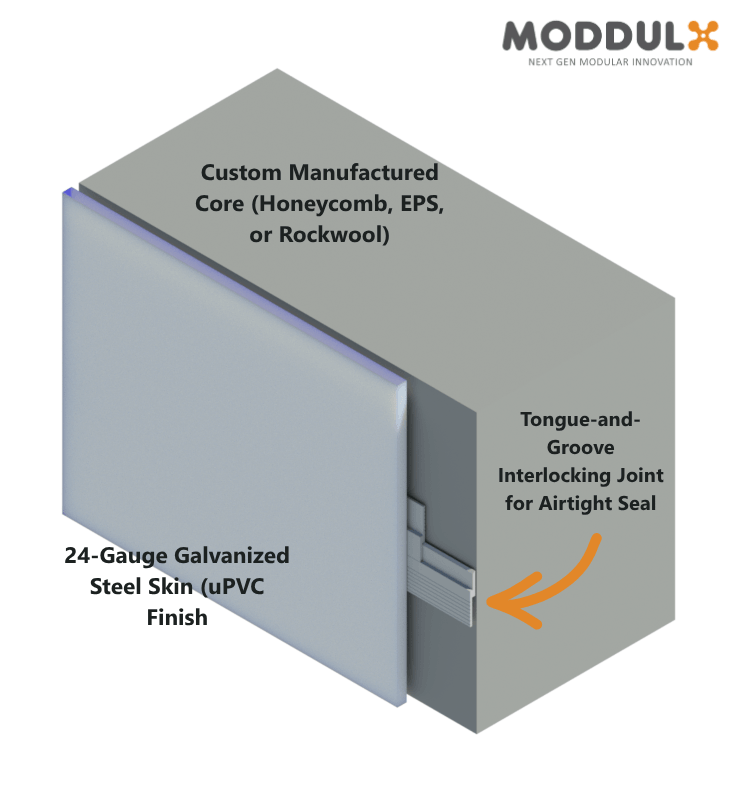
The outer sheet of a cleanroom panel - the surface you see, clean, and inspect - is consistent across all Moddulx configurations: a 24-gauge uPVC-coated galvanized steel skin with a smooth, non-porous finish. The core is where engineering diverges.
Core selection determines three non-negotiable performance variables:
Structural Load:
Selecting the core depends on whether the ceiling is walkable, whether long wall spans remain flat under load, and whether the panel is self-supporting.
Thermal Resistance:
The R-value that controls heat transfer, moisture behavior, and condensation risk at panel joints.
Fire performance:
The flame-spread index and smoke-developed index that determine code compliance and occupant safety.
These variables are not interchangeable. A core that excels in thermal insulation may be combustible. A core that delivers maximum rigidity may provide no meaningful thermal resistance. The three cores Moddulx manufactures each solve one primary engineering problem without compromising the others where it matters for the target application.
Aluminum Honeycomb Panels -Specifications and Applications
Aluminum honeycomb panels deliver the highest strength-to-weight ratio of the three core options. The cellular aluminum structure bonds to 24-gauge uPVC-coated GI steel facings on both sides, producing a panel that resists deflection across large spans without adding dead load to the structure.
Structural Load, Flatness Tolerances, and ISO Class 1–9 Support
The 50mm aluminum honeycomb sandwich panel supports walkable ceiling loads rated at 40lb/ft² (tested to ASTM E72-15, Section 9). The 25mm ceiling variant weighs approximately 1.4 lb/ft², making it one of the lightest overhead panel options available without sacrificing surface planarity.
Flatness is critical in particle-controlled environments. The honeycomb core maintains dimensional stability over time - it does not compress, creep, or absorb moisture. This makes the aluminum honeycomb panel the specified choice for ISO Class 1 through ISO Class 9 environments, where surface planarity and contaminant-free joints are classification requirements, not preferences.
The non-shedding, corrosion-resistant honeycomb core eliminates a contamination risk that foam-core alternatives carry in high-precision spaces. Panels are silicone or cold-welded at panel-to-panel interfaces to maintain airtight continuity.
Best-Fit Use Cases:
Aluminum honeycomb is the correct core for:
- Semiconductor wafer fabrication - where ISO Class 1–5 particle counts, precision flatness, and non-shedding surfaces are non-negotiable
- Pharmaceutical manufacturing - where chemical washdown resistance, GMP surface compliance, and FDA documentation requirements apply
- Walkable cleanroom ceilings - where HVAC access loads, maintenance traffic, and structural span requirements exceed what foam cores can support
Choose aluminum honeycomb when rigidity, flatness, and ISO classification support are the dominant engineering requirements.
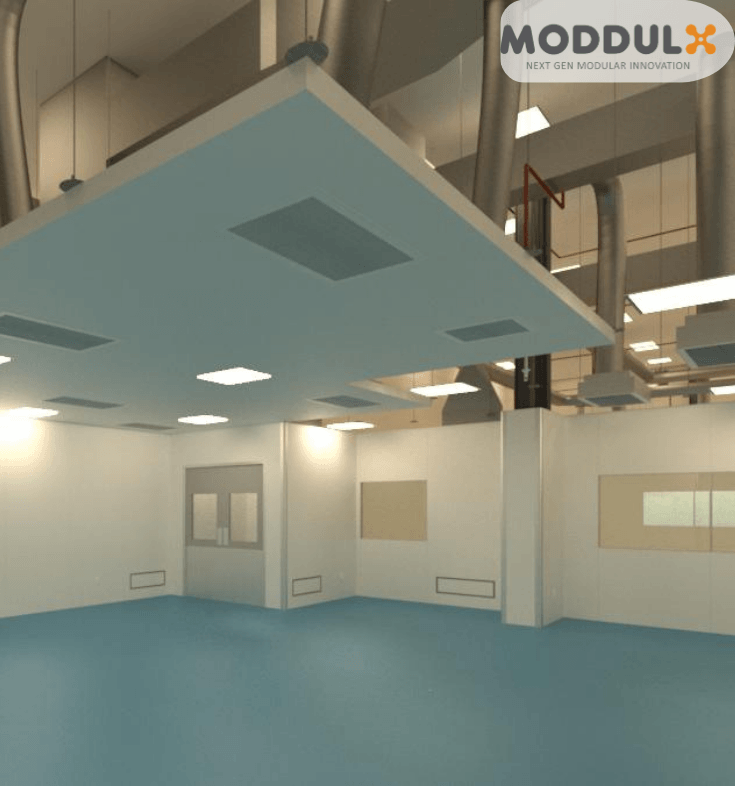
EPS Insulated Panels - Thermal and Airtight Performance
EPS insulated panels use an expanded polystyrene core to deliver maximum thermal resistance. The EPS core provides stable R-values over decades - the material does not off-gas, settle, or degrade in ways that cause R-value drift. At scale, EPS is the most cost-effective core option for facilities where temperature stability is the primary wall and ceiling function.
R-Value, Joint Air-Leakage Control, and Condensation Management
EPS core panels maintain consistent thermal resistance across the full service life of the panel. Panel-to-panel joint design is critical in temperature-controlled environments: Moddulx EPS panels are fitted with silicone or cold-weld joints that limit air leakage at the interface, reducing the thermal bridging that causes condensation and interstitial moisture problems.
The 50mm EPS sandwich panel weighs approximately 2.3 lb/ft² - lighter than both the aluminum honeycomb and Rockwool equivalents - which reduces structural load on ceiling systems and speeds installation. The 25mm EPS ceiling panel at approximately 1.2 lb/ft² is the lightest panel in the Moddulx range.
Note that EPS core is a combustible material. EPS panels are not the correct specification for applications where non-combustible assemblies are a code requirement.
Best-Fit Use Cases
EPS insulated panels are the correct specification for:
- Biotech laboratory walls and ceilings - where consistent temperature and humidity control support repeatable batch processes
- Cold-process production rooms - where sustained low-temperature operation requires high R-value envelope performance
- EV battery dry rooms -where moisture infiltration control is critical to cell integrity and the large facility footprint makes thermal efficiency a significant operational cost factor
Choose EPS when thermal performance and cost-efficiency at scale are the primary requirements and non-combustible construction is not a code mandate.
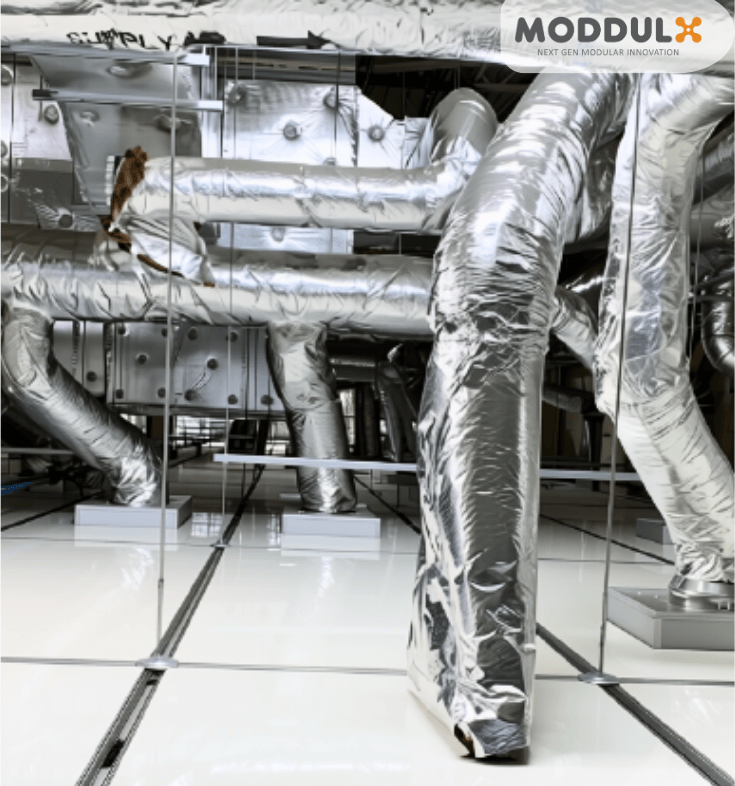
Rockwool Fire-Rated Panels -Fire and Acoustic Specifications
Rockwool fire-rated panels use a dense mineral wool core that is non-combustible by material classification. The Rockwool core does not sustain flame, does not contribute to smoke development, and provides meaningful acoustic attenuation - properties that no polymer-based core can match.
ASTM E84 Flame-Spread Index and Acoustic STC Ratings
Moddulx Rockwool panel assemblies are tested to ASTME84 (surface burning characteristics of building materials) and achieve a Class A rating - a flame-spread index of 25 or below and a smoke-developed index of 450 or below. Fire-rated assemblies are UL-listed under UL 723 and meet CAN/ULC S102 for Canadian builds.
The dense mineral wool core provides acoustic insulation that reduces sound transmission between fire-compartment zones and process areas. This makes Rockwool panels a dual-function solution in facilities where both life-safety fire ratings and acoustic separation requirements apply to the same wall assembly.
The 50mm Rockwool sandwich panel weighs approximately 3.5 lb/ft² - heavier than either alternative - which is a structural load factor to confirm with your structural engineer for ceiling applications.
Best-Fit Use Cases
Rockwool fire-rated panels are the correct specification for:
- Fire-compartment walls -where building codes mandate non-combustible construction and rated fire separation between production zones
- High-noise process areas -where acoustic attenuation is required alongside cleanroom surface performance
- Corridors and exit routes -where life-safety code requirements govern material selection independent of thermal or structural considerations
Choose Rockwool when non-combustible fire resistance is a code requirement. Do not substitute EPS or honeycomb cores in fire-rated wall assemblies.
Technical Comparison: Cleanroom Panel Core Specifications
Dimensions and weights are indicative. Exact specifications are confirmed on project drawings.
Certification and Compliance Requirements
Every cleanroom wall & ceiling panel manufactured by Moddulx is tested and certified to recognized standards. Compliance documentation is supplied with every order for inclusion in your project file.
- ISO 14644-1 governs the classification of air cleanliness in cleanrooms and associated controlled environments. All three Moddulx panel cores support ISO 14644-1 compliance across ISO Class 1–9 environments. The sealed surface, non-shedding core construction, and silicone-jointed panel interfaces are each specified to meet classification requirements.
- ASTME84 (Standard Test Method for Surface Burning Characteristics of Building Materials) determines flame-spread and smoke-developed indexes. Moddulx aluminum honeycomb and Rockwool panel assemblies achieve Class A performance under ASTM E84 testing, as well as under the equivalent UL 723 and Canadian CAN/ULC S102 standards.
- UL(Underwriters Laboratories) listing confirms that fire-rated Moddulx panel constructions have been independently evaluated for safety performance. UL listing documentation is available on request and is typically required for building permit submissions and authority-having-jurisdiction (AHJ) approvals.
- GMP and FDA compliance applies across all panel systems for pharmaceutical, biotech, and food processing builds. Moddulx supplies full specification and test documentation packages to support regulatory submissions and facility qualification processes.
Moddulx Production Flow - Spec to Site
Every Moddulx order follows a tracked four-step production process. The sequence runs from your drawings to your job site in a confirmed timeline that integrates with your construction schedule.
Cleanroom Panel Selection Checklist
Use this checklist before finalizing panel specifications for procurement. Each item resolves a specification variable that cannot be corrected after production begins.
Get a Panel Specification from Moddulx
Panel core selection is a specification decision, not a procurement shortcut. Aluminum honeycomb, EPS, and Rockwool each solve a distinct engineering problem - and the wrong core creates compliance failures that cannot be resolved after installation.
Moddulx manufactures all three panel cores to your drawings, with ASTM testing, UL listing, and ISO 14644-1 compliance documentation included. Standard volumes ship in 2–4 weeks from the Windsor, Ontario production line to job sites across the USA and Canada.
Email your drawings to sales@moddulx.com or call 1-877-663-3859 to request a panel specification and quote.
Frequently Asked Questions
What is the difference between aluminum honeycomb and EPS cleanroom panels?
Aluminum honeycomb panels deliver the highest structural rigidity, flatness, and strength-to-weight ratio. They are the correct choice for walkable ceilings, large-span walls, and ISO Class 1–5 precision environments. EPS insulated panels deliver maximum thermal resistance and are the cost-effective choice for temperature-controlled rooms, cold-process facilities, and EV battery dry rooms. EPS cores are combustible; aluminum honeycomb is non-combustible and achieves ASTM E84 Class A ratings.
Are Moddulx cleanroom panels ISO 14644-1 compliant?
Yes. All three Moddulx panel cores - aluminum honeycomb, EPS insulated, and Rockwool fire-rated - support ISO 14644-1 compliance across ISO Class 1–9 environments. Full compliance documentation is available on request for inclusion in your project file or regulatory submission.
What fire rating do Moddulx Rockwool panels achieve?
Moddulx Rockwool fire-rated panels achieve ASTM E84 Class A performance (flame-spread index ≤25,smoke-developed index ≤450). Assemblies are also tested to UL 723 and CAN/ULCS102. Fire-rated constructions are UL-listed by Underwriters Laboratories. Documentation is supplied for AHJ submissions on request.
Can Moddulx panels be specified for walkable cleanroom ceilings?
Yes. The 50mm aluminum honeycomb sandwich panel is rated for walkable ceiling loads of 40lb/ft², tested to ASTM E72-15 Section 9. The EPS and Rockwool 50mm panels are self-supporting for walls and ceilings but walkable load ratings should be confirmed with the Moddulx team for specific spans and load conditions.
What is the lead time for Moddulx cleanroom panels?
Standard volume orders ship in 2–4 weeks from spec approval. Spec approval typically takes 2–4days once drawings are received. Larger turnkey projects are scheduled around the construction program - contact the Moddulx team early for builds with tight timelines.
What certifications does Moddulx supply with panel orders?
Moddulx supplies ASTM E84-17, UL 723, and CAN/ULC S102 test documentation, ISO 14644-1 compliance records, and GMP and FDA compliance documentation on request. Full specification packages are available for project files, permit submissions, and regulatory approvals.